

 Dara Correia
 In an increasingly competitive and digital market, companies face the ongoing challenge of optimizing their sales processes to achieve better results. Building an effective sales funnel has become essential for guiding potential customers from first contact to final conversion. To do this, using Marketing Technology (MarTech) tools like Zoho and HubSpot—which offer integrated solutions that facilitate the management and automation of every funnel stage from visitor attraction to customer retention—is crucial.
A well-structured sales funnel not only maps consumer behavior, but also helps identify bottlenecks in the commercial process, measure results, and improve communication between marketing and sales teams. Zoho and HubSpot stand out by offering complete functionalities for each funnel stage, integrating automation, artificial intelligence, and custom reports. This article explores how to build an efficient sales funnel using these two platforms—and how technology, when paired with strategy, can transform commercial performance.
What is a Sales Funnel?

A sales funnel is a visual and strategic representation of the journey a potential customer takes from the first contact with a company to the moment of purchase. This funnel-shaped metaphor helps illustrate how many people come into contact with a brand, but only a portion of them proceed to the final purchase decision.
In practice, the funnel organizes this journey into different stages with the goal of making marketing and sales actions more effective. It helps companies identify which stage their potential customers are in, what they’re looking for, what their needs are, and the best channels or messages to move them forward. It also allows businesses to forecast results, measure conversions, and pinpoint where improvements in commercial performance can be made.
Classic Sales Funnel Model:
- Top of the Funnel (ToFu) – This is when a potential customer becomes aware of a problem or need. At this stage, they are not yet looking for specific solutions. Therefore, the focus should be on providing educational content, blog articles, explainer videos, or free resources that help identify the problem and generate interest.
- Middle of the Funnel (MoFu) – Here, the potential customer is aware of the problem and starts looking for ways to solve it. They assess different solutions, compare options, and show clear signs of interest. This is the ideal time to offer more in-depth content such as eBooks, case studies, webinars, or product demos.
- Bottom of the Funnel (BoFu) – At this final stage, the potential customer is ready to make a decision. They already know what they need, have compared providers, and are choosing the best option. At this point, the company should provide clear sales arguments: commercial proposals, diagnostic sessions, free trials, among other incentives.
A well-defined sales funnel helps companies treat each lead in a personalized way, addressing their questions and needs at each stage, rather than using a generic approach for everyone. This strategy improves the customer experience and increases the efficiency and conversion rate of leads into actual customers.
Checklist: How to Align Marketing and Sales
Building the Sales Funnel with Zoho

Zoho is a modular business software platform offering a wide range of integrated applications for marketing, sales, support, productivity, and data analysis. Zoho CRM, in particular, is the central tool for building and managing a sales funnel effectively—even for those without technical experience.
1. Lead Capture
Every funnel starts with attracting and capturing potential customers. In Zoho CRM, you can create custom forms to embed on your website, email campaigns, or social media. Whenever someone fills out a form, the data is automatically recorded in the CRM as a new lead, with all the information needed to start the follow-up process.
Zoho also integrates with external tools like Facebook Leads, Google Ads, or offline events (via QR codes, for example), helping centralize all contacts into one system.
2. Lead Qualification
Not every captured contact is ready to buy. That’s why Zoho provides a lead scoring system, where each lead is assigned a score based on their behavior: did they open emails? Visit product pages? Fill out a form? The score helps the sales team quickly identify the most interested contacts.
You can set up automation rules so that, when a lead reaches a certain score, it is automatically assigned to a sales rep or moved to a new stage in the funnel.
3. Marketing Automation
With Zoho Campaigns or Zoho Marketing Automation, you can create segmented email campaigns, send newsletters, or build automated communication flows—such as sending a welcome email upon registration or an educational sequence after downloading an eBook.
These automations keep leads engaged with the brand over time, nurturing their interest until they are ready to speak with a salesperson.
4. Sales Pipeline Management
In the Deals module, you can track the journey of each opportunity. Visually, users see all opportunities organized by stage (e.g., first contact, proposal sent, negotiation, closed won/lost). This pipeline offers visibility into deal volume, revenue forecasts, and where opportunities are being lost.
Each record includes a full history of emails, calls, tasks, and notes, ensuring everyone involved in the sale has access to the same context.
5. Reports and Analytics
Using Zoho Analytics, CRM data can be transformed into interactive reports and custom dashboards. You can measure stage-to-stage conversion rates, average time to close, individual sales rep performance, campaign ROI, and more. These analytics help refine the funnel and make decisions based on real data.
Webinar: Artificial Intelligence in Zoho CRM
Building the Sales Funnel with HubSpot

HubSpot is one of the most comprehensive MarTech platforms available, offering integrated modules for marketing, sales, support, and CRM. Ideal for both small businesses and large teams, HubSpot stands out for its ease of use, advanced automations, and customer-centric approach. Below is how to build an effective sales funnel using HubSpot tools.
1. Visitor Attraction
The first funnel stage—attracting visitors—is handled through the Marketing Hub. With this module, you can create SEO-optimized content, publish blog articles, manage social media, and run ad campaigns. The goal is to generate qualified website traffic and spark interest in your products or services.
All visitor interactions are recorded in the CRM—even before they fill out a form—allowing future communications to be personalized based on behavior.
2. Lead Conversion
Conversion occurs when a visitor provides their data in exchange for something valuable (an eBook, a free consultation, etc.). HubSpot makes it easy to create landing pages, dynamic forms, and custom calls to action (CTAs).
You can also implement chatbots and live chat to answer questions and capture leads in a more interactive and human way. These details are automatically stored in the CRM and integrated with the rest of the funnel.
3. Lead Nurturing and Segmentation
After capturing contacts, it’s vital to keep them engaged and guide them toward a buying decision. HubSpot provides Workflows—automation flows that send email sequences, update CRM properties, or change lead status based on behavior.
You can also segment contacts based on engagement (e.g., opened emails, visited key pages, downloaded materials), ensuring each message is relevant to their stage in the funnel.
4. Opportunity Management
With Sales Hub, sales reps can manage all opportunities in a visual and interactive pipeline. Each deal shows associated activities, interaction history, scheduled tasks, and probability of closing.
Features like meeting scheduling, email templates, automatic call logging, and Gmail or Outlook integration make sales teams more efficient. Integration with tools like Zoom or Google Meet also simplifies remote meetings.
5. Performance Reporting
HubSpot offers detailed and customizable dashboards to track conversion rates, average stage duration, individual rep performance, lead sources, and much more. These insights are essential for adjusting strategies, better allocating resources, and forecasting revenue.
Webinar: Artificial Intelligence in HubSpot
How to Optimize Your Sales Funnel
Building a sales funnel is only the first step. To ensure consistent and scalable results, it’s essential to implement a continuous optimization process. This means monitoring the performance of each stage, identifying friction points, and adopting improvements based on concrete data. A funnel that is not regularly reviewed and adjusted tends to lose effectiveness, harming both the customer experience and conversion rates.
Key Metrics Analysis
The first way to optimize the sales funnel is by analyzing key metrics. It is essential to track indicators such as conversion rates by stage, the average time leads spend in each phase, the origin of the highest-converting leads, and the most common reasons for lost opportunities. Tools like Zoho Analytics and HubSpot dashboards provide real-time data that helps teams make faster and more informed decisions.
Marketing & Sales Alignment
Another critical factor is alignment between marketing and sales. Often, teams operate in silos, which hinders the smooth movement of leads through the funnel. To optimize this process, it’s important to define clear qualification criteria (e.g., lead scoring), establish service-level agreements (SLAs) between departments, and maintain constant communication. When marketing delivers better-prepared leads and sales acts quickly with context, the success rate increases significantly.
Personalized Communication
Personalized communication is another key element in optimization. By using automation and segmentation tools—available in both Zoho and HubSpot—you can adapt messages, channels, and content to the stage and profile of each lead. For example, a top-of-funnel contact may receive educational content, while a decision-stage lead should receive a personalized proposal or product demo. This approach shortens the sales cycle and enhances the lead’s experience.
Continuous Training
Finally, ongoing training for teams and periodic process reviews are essential. An effective sales funnel depends on the team’s ability to interpret data, adapt to new buying behaviors, and use technological tools strategically. Workshops, collaborative review sessions, and process updates should be part of the sales team’s routine.
Sales funnel optimization is not a one-time task but a permanent effort of improvement. Companies that embrace this mindset are more agile, better at forecasting results, and more capable of building lasting relationships with customers.

The Role of Artificial Intelligence in the Sales Funnel
Digital transformation has led companies to rethink their commercial strategies, and artificial intelligence (AI) now plays a central role in this new paradigm. In the context of the sales funnel, AI is no longer just a promise for the future—it is a reality that is redefining how businesses identify, engage, and convert their customers. By analyzing large-scale data, automating repetitive tasks, and predicting behavior based on historical patterns, artificial intelligence helps sales teams make more informed, faster, and more effective decisions.
Both Zoho and HubSpot have integrated AI functionalities into their platforms, offering practical and accessible solutions that significantly improve lead and opportunity management. These technologies not only accelerate the commercial process but also allow for a more personalized and strategic approach at every stage of the funnel. Below are the main AI features available in each platform and their direct impact on sales performance.
Make your Business grow with IT
Artificial Intelligence in Zoho
Zoho introduced an AI assistant called Zia, which offers several functionalities:
- Predictive Analytics: Zia analyzes data patterns to predict lead behavior, helping prioritize opportunities.
- Anomaly Detection: Identifies deviations in sales performance, enabling rapid corrective action.

- Task Automation: Suggests automations based on user behavior, increasing operational efficiency.
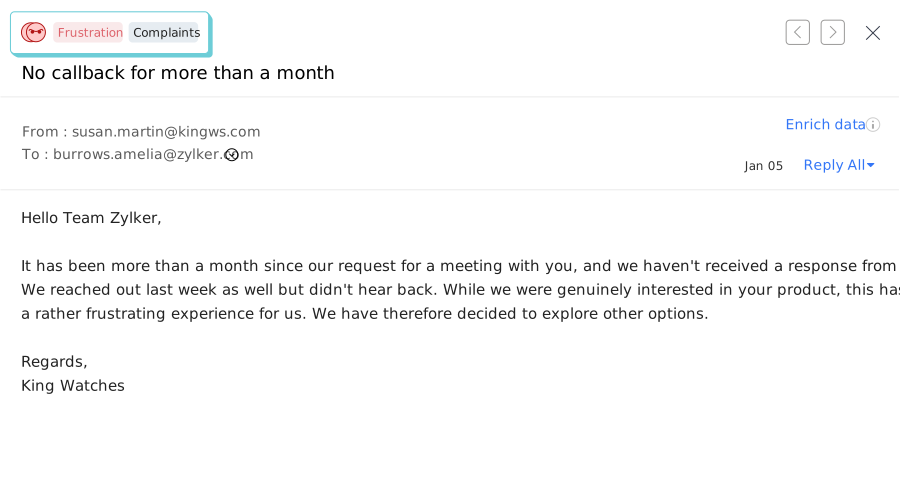
- Sentiment Analysis: Assesses the tone of customer interactions, providing insights into satisfaction and potential areas for improvement.
Artificial Intelligence in HubSpot
HubSpot has also integrated AI features into its platform:
- Automated Lead Scoring: Assigns scores to leads based on behavioral and demographic data, making prioritization easier.
- Content Recommendations: Suggests relevant content for each lead, increasing engagement.

- Conversation Analysis: Uses AI to transcribe and analyze sales calls, offering feedback for improvement.

- Sales Forecasting: Provides estimates on deal closures based on historical and behavioral data.
Conclusion
Building an effective sales funnel, supported by MarTech tools like Zoho or HubSpot, is now a cornerstone of sustainable business growth. More than just a theoretical model, the funnel represents a practical and measurable approach that helps align teams, increase productivity, and deliver a more consistent and personalized customer experience. When integrated into these platforms, artificial intelligence further amplifies the potential for results—offering predictive data, intelligent automation, and strategic insights.
At Liminal, we believe that technology only creates value when integrated into a broader vision. We help companies not only choose the right tools but also ensure their strategic implementation and real adoption by teams. Building an effective sales funnel depends not only on technology but also on the ability to align processes, people, and objectives. It is at this intersection between strategy, marketing, and technology that Liminal operates—ensuring that every digital investment contributes directly to business outcomes.
Rely on Liminal’s CRM Experts
The world of Marketing and Technology is constantly evolving. It is increasingly important to count on specialists who can ensure the successful integration of innovation into your business. For technology to truly drive business success, a well-defined strategy is essential — one that guides the implementation, adoption, and evolution of systems.
As MarTech specialists, Liminal offers an integrated perspective that combines Technology, Marketing, and Strategy. We ensure successful adoption and implementation of marketing technologies — whether by helping you select the right systems for your company’s challenges, adapting processes and workflows within existing platforms, or developing a tailored CRM & Automation strategy that supports business growth.