

 Dara Correia
 In recent years, the way companies collect, organize, and use customer data has changed radically. Digitalization has brought with it an increasing volume of information from various touchpoints such as websites, social media, email campaigns, customer service interactions, e-commerce, and more. In this context, organizations are increasingly seeking tools that allow them to transform this dispersed data into strategic, actionable knowledge. It is in this scenario that the distinction arises between CRM (Customer Relationship Management) and CDP (Customer Data Platform), two technologies often confused but with very different roles.
While CRM is already widely known and used by companies as a tool for managing relationships and monitoring the sales cycle, CDP presents itself as an evolution that responds to a growing challenge: the unification and analysis of data from multiple sources, in real time, to create complete and actionable customer profiles. On the one hand, CRM helps teams manage direct interactions with leads and customers, while on the other, CDP expands the view and offers a holistic understanding of who these customers are, how they behave, and what are the best ways to personalize their experience.
For SMEs, the central question is to understand whether a CDP is truly necessary or if the functionalities of a CRM, such as Zoho CRM or HubSpot CRM, are already sufficient to meet their needs. After all, do all companies need to invest in complex and higher-cost solutions like CDPs, or can a well-configured CRM play that role effectively? Throughout this article, we will explore the differences, complementarities, and advantages of each approach, with the aim of clarifying the right time to consider the transition or the combination of the two technologies.
1. What is a CRM and what role does it play in companies?

CRM (Customer Relationship Management) is a tool designed to centralize and manage all interactions that a company has with its customers and potential customers. Its main function is to structure information in an organized way, allowing sales, marketing, and customer support teams to access a complete history of contacts, conversations, proposals, and purchases. In practice, CRM helps track each lead from the first interaction through to the sale, as well as maintain strong relationships with existing customers.
In addition to data recording, modern CRMs include automation functions such as sending segmented emails, creating automatic tasks for sales reps, lead scoring (based on behavior or profile criteria), and detailed reports on the sales pipeline. Tools like Zoho CRM or HubSpot CRM are clear examples of this evolution. Zoho CRM stands out for its flexibility and integration with more than 40 applications within the Zoho ecosystem, allowing workflows to be customized and marketing, sales, and operations to be unified on a single platform. HubSpot CRM, on the other hand, has gained notoriety for its intuitive interface and the way it combines marketing automation, contact management, and sales reporting in a single accessible space, being particularly popular among growing small and medium-sized businesses.
In summary, CRM is essential for any company that wants to manage customers in a professional and strategic way. It offers not only organization but also intelligence about sales cycles, helping to identify bottlenecks, measure team performance, and create a more personalized approach with each customer.
2. What is a Customer Data Platform (CDP)?
A Customer Data Platform (CDP) is a more recent technology with a distinct purpose from CRM: to create a unified, centralized database that collects, integrates, and updates in real time all customer information from multiple channels. While CRM mainly records commercial interactions, CDP goes further and integrates data from sales, marketing, websites, social media, e-commerce, mobile apps, customer support, analytics, and even IoT devices. The goal is to build a single, complete profile of each customer, enabling a 360-degree view.
CDPs stand out for their ability to work with data in real time. This means that if a customer interacts with a Facebook ad, abandons a shopping cart on an e-commerce site, and then opens a company email, all these actions are automatically recorded and associated with the same profile. This type of technology is especially useful in personalization strategies, where companies need to adapt messages, offers, and experiences according to customer behavior across multiple touchpoints.
Examples of popular CDPs include Segment (focused on data collection and distribution), BlueConic (which emphasizes personalization and real-time activation), and Salesforce CDP, integrated into the vast Salesforce ecosystem. These solutions are often adopted by large companies dealing with millions of customers and highly diverse interaction channels, but their cost and complexity can make them less accessible or necessary for SMEs.
In short, while CRM answers the question “How are we managing the relationship with customers?”, CDP answers “Who are our customers really, and how do they interact with us across all channels?”
3. What are the main differences between CRM and CDP?
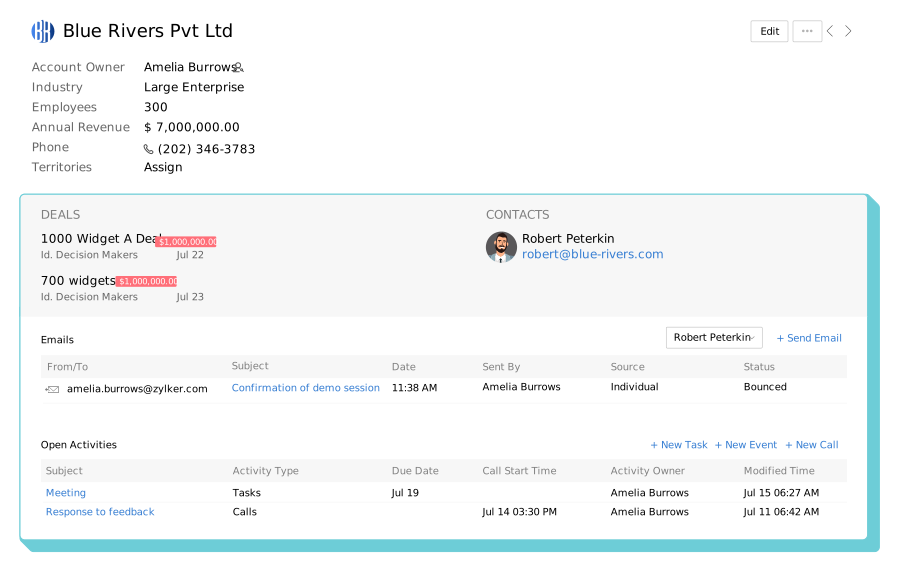
Although both deal with customer data, CRM and CDP have very different objectives and architectures. CRM is essentially a tool oriented towards managing relationships with customers and leads throughout the sales cycle. It stores contact information, interaction history, business activities, exchanged emails, scheduled meetings, and open opportunities. CRM is the natural space for sales and marketing teams, who use it to track each stage of the sales funnel and ensure that no contact is lost.
CDP goes far beyond this transactional record. Its main function is to collect, consolidate, and organize data from various internal and external sources, from website visits, clicks on digital campaigns, and social media interactions to e-commerce purchases or customer service calls. CDP not only centralizes this information but also creates a unified customer profile, often enriched by artificial intelligence and advanced segmentation. Instead of only looking at the “what” of the relationship, like CRM, CDP helps understand the “why” of behavior, anticipating needs and enabling personalization at scale.
In practice, CRM can be said to be more operational, focused on day-to-day management of contacts and business, while CDP is more analytical and strategic, acting as a brain that processes complex data to generate insights. One complements the other, but they are not the same.
Marketing Automation: 7 ways to increase sales
4. What type of data does each platform manage?

The difference between CRM and CDP becomes even clearer when analyzing the types of data each platform manages.
In CRM, the data is generally structured and identifiable: name, email, phone number, company, purchase history, scheduled meetings, support tickets, among others. This system essentially works with information consciously provided by the customer or collected during direct interactions. Thus, CRM data has a relational nature and is fundamental for managing each contact individually, tracking the sales funnel, and personalizing commercial communications.
CDP, on the other hand, can handle both structured and unstructured data, as well as anonymous data. This includes real-time behavioral information such as pages visited on a website, time spent, ad clicks, devices used, location, browsing preferences, chatbot interactions, and even offline campaign metrics. The big differentiator is that CDP can unify these scattered data points into consistent profiles, connecting digital identity with the known records in CRM.
While CRM provides a view of “who the customer is and how they relate to the company”, CDP delves deeper into “how the customer behaves and what that behavior indicates about future actions.”
5. When does it make sense to invest in a CDP instead of just a CRM?
This is perhaps the most critical question for many SMEs that already use a CRM like Zoho or HubSpot and wonder if they need to take the next step towards a CDP. The answer depends primarily on the digital maturity of the company and the complexity of its operations.
A CRM is more than enough for companies that:
• Work with direct and relatively short sales cycles.
• Do not have multiple data acquisition channels running simultaneously.
• Mainly value contact management, opportunities, and relationship history.
• Aim to centralize sales and marketing team work in a practical and accessible way.
On the other hand, a CDP makes sense in organizations that:
• Operate across multiple digital and offline channels.
• Require enriched, real-time customer profiles for complex segmentations.
• Handle large volumes of dispersed data that need to be integrated to generate actionable insights.
• Strongly invest in personalized marketing strategies and behavior-based campaigns.

Thus, while for many SMEs a well-configured and optimized CRM remains the sufficient foundation, companies in rapid growth or with a multichannel digital presence may find in CDP the key to unlocking advanced personalization and market intelligence.

6. What are the risks and challenges of adopting a CDP?
Although a CDP brings significant advantages in terms of centralization and data intelligence, its adoption is not without risks and challenges. The first obstacle is usually the initial investment. CDP platforms are generally more expensive than CRMs, both in licensing and implementation. This includes costs with integrations, data migration, team training, and in some cases, technical consulting to configure data flows. For an SME with a limited budget, this can be a decisive factor.
Another challenge is technical complexity. Unlike CRM, which is relatively simple to adopt and configure, CDP requires a more mature digital ecosystem. It is necessary to ensure that all data sources—websites, social media, e-commerce systems, apps, among others—are properly connected. Otherwise, there is a risk of feeding the platform with incomplete or inconsistent data, which compromises the quality of analysis.
There is also the issue of privacy and legal compliance. Since CDP deals with large volumes of data, including behavioral and sometimes sensitive information, it is essential to strictly comply with regulations such as GDPR in the European Union. A governance error can result not only in heavy fines but also in serious reputational damage.
Finally, there is the risk of underutilization. Many companies invest in CDPs without a clear strategy for how the data will be used. They end up with a powerful but underexplored platform, turning a robust investment into an expensive and inefficient solution.

7. Do Zoho and HubSpot already cover some CDP functionalities?
Both Zoho and HubSpot have evolved significantly in recent years, expanding their CRM platforms to offer functionalities traditionally associated with CDPs. These solutions may not be a full replacement for a robust CDP, but for many SMEs they are sufficient to address the need for data centralization and advanced personalization.
7.1 Zoho: CRM + Zoho One as an alternative to CDP
Zoho stands out for its strategy of offering a complete ecosystem of more than 45 integrated applications through the Zoho One package. In practice, this brings the experience closer to a CDP, since all sales, marketing, finance, operations, and support data naturally flow between applications without the need for complex integrations.
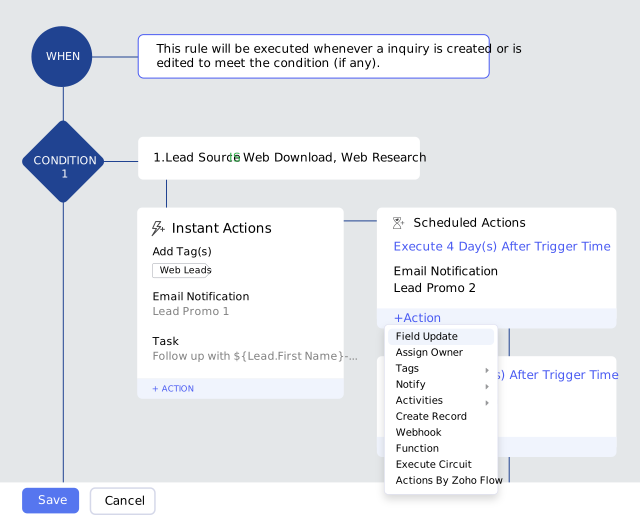
Zoho CRM records and organizes customer data, but when complemented with tools like Zoho Analytics (for BI and advanced dashboards), Zoho Campaigns (for marketing automation), Zoho SalesIQ (for online behavior tracking), and Zoho Desk (for support and tickets), it builds a unified view of the customer across different touchpoints.

One of Zoho’s major differentiators is accessibility. Unlike traditional CDPs, which require high investments, Zoho One offers equivalent functionalities at a predictable and competitive cost. Furthermore, with the support of Zoho Creator, it is possible to customize applications and workflows without advanced programming, ensuring faster adaptation to each company’s needs.
In short, for SMEs seeking a solution that comes close to a CDP without the financial and technical burden, Zoho presents itself as a highly viable and scalable option.
7.2 HubSpot: CRM with integrated CDP functionalities
HubSpot follows a similar philosophy, offering a free central CRM that expands with specific hubs for marketing, sales, service, and operations. This model allows companies to consolidate data from different touchpoints, creating a centralized base that already incorporates some typical CDP functions.
With the Marketing Hub, for example, it is possible to track leads’ digital behavior—from website visits to campaign clicks and social media interactions. The Service Hub records support tickets and interactions, while the Operations Hub ensures integrations and real-time data synchronization with other external tools. All these elements are centralized in the CRM, which acts as the platform’s core.
HubSpot also differentiates itself with usability and intuitive design, reducing the learning curve. In addition, the platform has heavily invested in artificial intelligence (with HubSpot AI and Breeze features), which help generate automatic insights, predict outcomes, and even create personalized content.

Although not a pure CDP, HubSpot offers functionalities sufficient for most SMEs, especially those focused on inbound marketing and alignment between sales and marketing teams. For many companies, adopting HubSpot eliminates the need to invest in a dedicated CDP, at least in the early stages of digital growth.
8. Do all SMEs need a CDP?
The short answer is: not necessarily. Despite all the attention CDPs have received, it is important to recognize that not all small and medium-sized businesses need a solution of this scale. For many, a robust and well-configured CRM already covers most needs, allowing them to manage leads, track opportunities, automate marketing campaigns, and consolidate relevant sales data.
A CDP becomes more relevant in contexts of high digital complexity: companies operating in several countries, with multiple digital and offline channels, or managing large volumes of customer data. In these situations, the unification and advanced segmentation that a CDP offers can be decisive.
For most SMEs, the focus should be on extracting maximum value from existing tools, such as Zoho or HubSpot, before considering a move to a CDP. Often, the problem is not the absence of a platform but rather the underutilization of the CRM’s capabilities already in place.

9. What are the common mistakes companies make when evaluating CRM vs CDP?
One of the most common mistakes is believing that a CDP replaces a CRM. In fact, these tools serve different purposes: CRM is the operational center of customer relationships, while CDP acts as a data aggregator and enhancer. Another frequent mistake is investing in technology without a clear strategy. Adopting a CDP is not enough if the company does not have mature processes for collecting, managing, and using data.
There is also a tendency to overestimate needs. Many companies are seduced by innovation pitches and believe they need a CDP when in reality they have not yet explored the full potential of their CRM. This rushed decision can generate high costs and unnecessary complexity.
Finally, a critical mistake is ignoring the human factor. Any data technology will only have an impact if it is used consistently by the teams. Investing in training, data culture, and strategic alignment is just as important as choosing the platform itself.
10. The future: will we see a merger between CRM and CDP?
As the Martech market evolves, many experts believe that the boundary between CRM and CDP will become increasingly blurred. Already today, platforms like Zoho and HubSpot offer hybrid functionalities that combine relationship management with consolidation of behavioral data, approaching a CDP without abandoning CRM’s operational core.
It is possible that, in the near future, we will see a natural integration between the two categories, with platforms that offer both contact management and advanced data unification, supported by artificial intelligence. This convergence will bring clear benefits: less system fragmentation, lower costs, and smoother processes for companies.
For SMEs, this means that the best strategy may be to invest in flexible solutions like Zoho or HubSpot, which continuously evolve and can adapt to growth and new market demands without the need for major technological leaps.
Conclusion
The distinction between CRM and CDP is fundamental for companies to make the right decisions about their management and data tools. While CRM remains the core of customer relationships, focused on contacts, history, and sales pipeline, CDP emerges as a strategic enhancer capable of consolidating multiple data sources and generating enriched profiles.
For many SMEs, however, a robust CRM—especially solutions like Zoho and HubSpot—already covers most of the necessary functionalities, from automation to predictive analysis. The decision to invest in a CDP should always be linked to the level of digital maturity, the volume of data, and the real need for personalization at scale.
The greatest risk does not lie in choosing a “smaller” tool but in not fully using the capabilities of those already available. Therefore, the priority for many organizations should be to extract all the value from their CRM, align processes, and foster a data-driven culture before considering a more robust investment in a CDP.
At Liminal, we believe technology should serve strategy, not the other way around. As certified Zoho partners and HubSpot specialists, we help companies realistically assess their needs, implement impactful solutions, and create a smarter relationship with data. If the goal is to turn information into a real competitive advantage, we are ready to support every step of that journey.
Rely on Liminal’s CRM Experts
The world of Marketing and Technology is constantly evolving. It is increasingly important to count on specialists who can ensure the successful integration of innovation into your business. For technology to truly drive business success, a well-defined strategy is essential one that guides the implementation, adoption, and evolution of systems.
As MarTech specialists, Liminal offers an integrated perspective that combines Technology, Marketing, and Strategy. We ensure successful adoption and implementation of marketing technologies whether by helping you select the right systems for your company’s challenges, adapting processes and workflows within existing platforms, or developing a tailored CRM & Automation strategy that supports business growth.
Referência de imagem CRM vs. CDP: https://www.superoffice.com/blog/crm-cdp/